


A Blog Post by Elisabeth Schenk
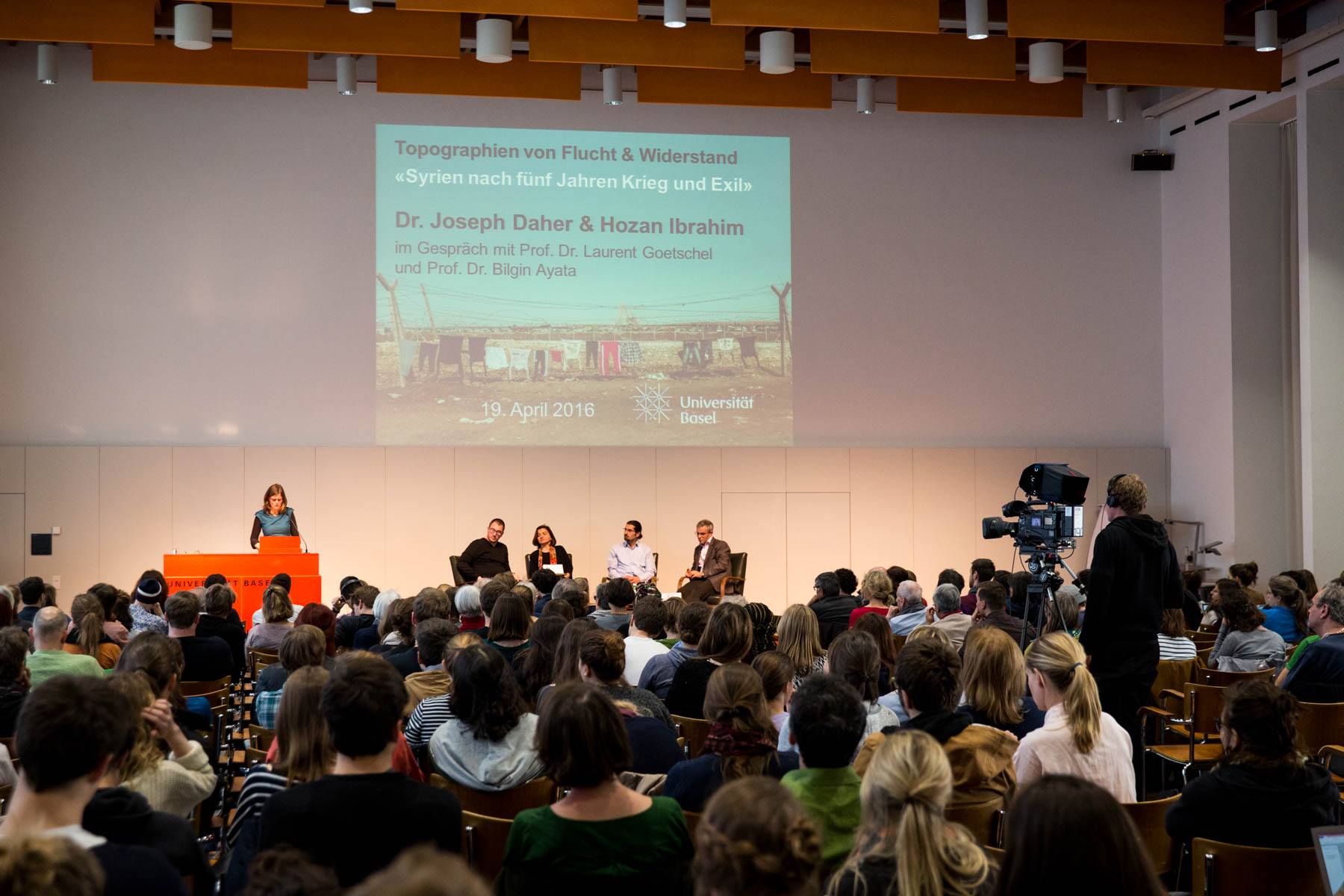
Photo by Ruben Hollinger, rubenhollinger.ch
Invited guest to the discussion about “Syria after five years of war and displacement” were Joseph Daher and Hozan Ibrahim. Joseph Daher is historian and political scientist and his study focus is the Middle East. Hozan Ibrahim is founder of the Non-Governmental Organisation “Citizens for Syria”.
During the podium discussion the speakers presented their view about the general situation in Syria, the third negotiation in Geneva as well as the role of international and regional actors. Moreover, they discussed the possible solutions for an end of war in Syria. In this blog post, I will focus on the perspective of Joseph Daher regarding the continuation of the Syrian revolution and possible solutions for an end of the conflict in Syria.
Syrian Revolution – class interests of the Syrian People
Out of the daily news, we know that the Assad Regime is in a permanent war against the Syrian population. However, we also observe the continuation of the Syrian revolution. When explaining the general situation in Syria, Joseph Daher focused on the numerous demonstrations in the liberated regions, bringing back the democratic demands of the Syrian people against the Assad Regime, but also IS. The origin of the Syrian revolution and the reasons for the continuing demonstrations are the fight for a democratic, no racist and no sectarian Syria as well as demands for social, economic and political justice. This focus on the primary reasons for the revolution is central, if we want to find a solution for Syria.
Moreover, Joseph Daher emphasised that the continuing demonstrations reveal that we are observing in Syria a long term revolutionary process. People living on the bottom of the society don’t accept anymore their precarious way of living. However, the two counter-revolutions were not able to respond to the population’s demands for social justice, democracy and equality. Thus, so Daher, the “political window” from 2011 is still open and the revolutionary potential is not at the end, even if it is heavily weakened through the evolution of the recent fights in Syria.
The Negotiation of Geneva – Economic and Political Interests of the Bourgeoisie Class
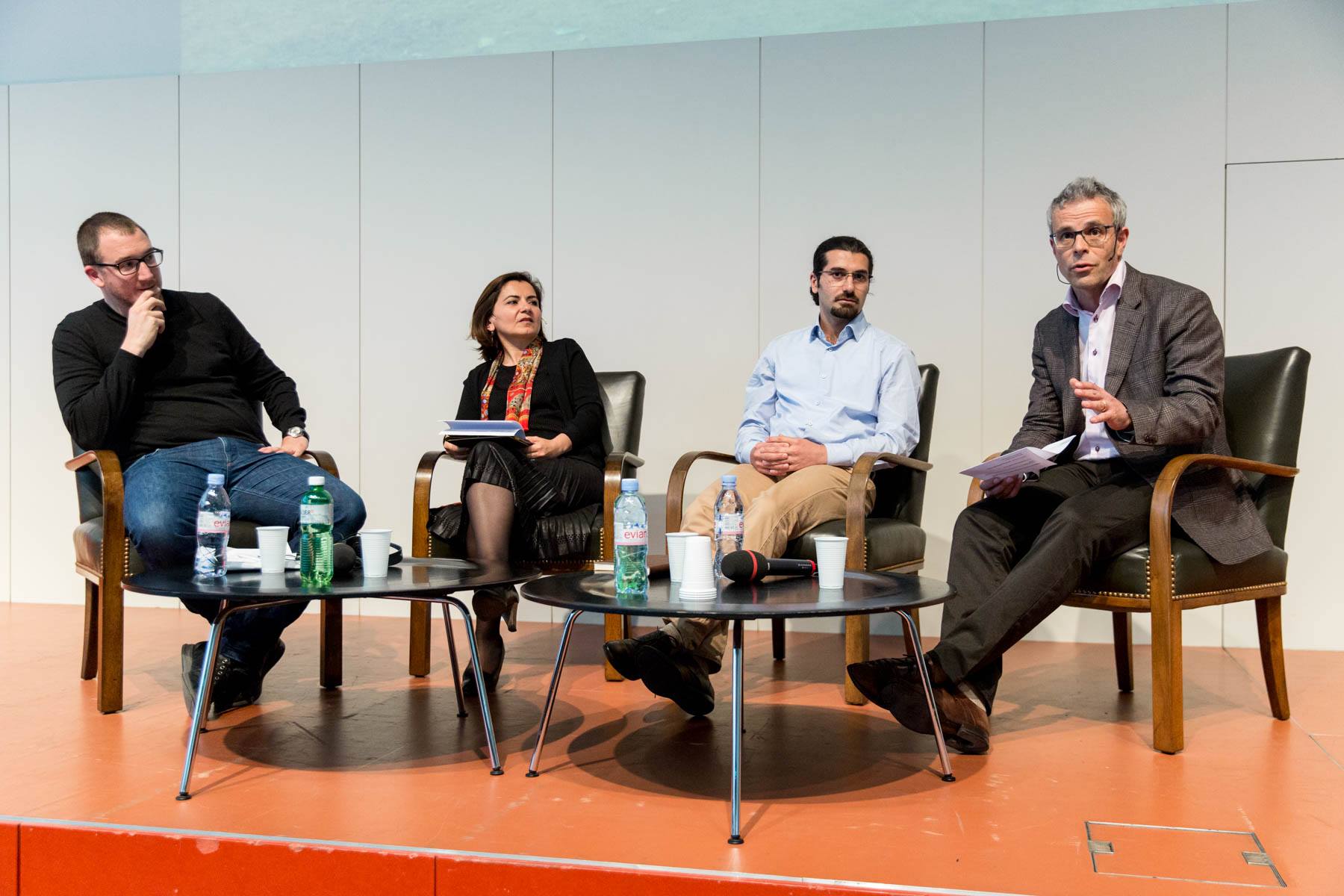
Photo by Ruben Hollinger, rubenhollinger.ch
The Assad Regime gains more and more territories. Therefore, the actual negotiation position for the revolutionary groups is worse than it was two years ago in 2011, when the second Negotiation of Geneva took place. The Assad Regime as patrimonial state, where the political, economic and military power is in the hand of the Assad family, has no interest in a power transition or any other kind of compromise. International actors as Russia, Iran, Saudi-Arabia or Israel have for different political and economic reasons an interest for stability in the region. Since the Assad Regime is considered as a guarantor for stability, the international community does not have the interest for a regime change. This is why Daher stated that the same political frame, as it existed two years ago, will dominate the Negotiation of Geneva. There is no will for radical changes. The objective is still to maintain the structure of the Assad Regime.
In addition, the circumstances of the third Negotiation Round in Geneva changed tremendously in favour of the Assad regime. There is therefore an increased pressure in order to find a peace bringing solution. After two years of increased terror from the Assad Regime as well as from the Islamic State, the Syrian population is fed up with the continued war situation. Moreover, the radical Islamic group Islamic State spread heavily in Syria and managed to execute numerous terror attacks in the western world. Third, the European states make pressure to solve the so called “refugees crisis”.
Two perspectives for the future of Syrian are dominating the international community. Either Assad stays in power in order to limit the destabilization of the region or he leaves in order to split up the country, since different groups will fight for power. Arguing that the second scenario would imply a consolidation of the power of the IS and a growing amount of refugees, the first perspective is justified by international actors.
Is there an alternative solution to Assad?
Photo by Ruben Hollinger, rubenhollinger.ch
Yet, are there only these two possibilities? The central issue of the podium discussion referred to the international and regional powers. But what about the people? Can’t we imagine a solution of the conflict where the power is given to the people similar to the democratic experience we observe in the region of Rojava in the north of Syria?
Joseph Daher argues that the causes for the existence of Daesh are on the one hand the oppression of the population under an authoritarian regime and on the other hand the imperialist interventions of international actors. Thus, the causes for the actual problem of the IS and the so called refugee “crisis” have their origin in the economic and foreign policy of the western states themselves.
Therefore, the final question mentioned by Prof. Dr. Laurent Goetschel is indeed: On what grounds and with what priorities do we want to solve this situation in Syria? Is it, as the actual negotiations in Geneva are favouring, the political and economic interests of the bourgeois class? Or do we rather assign our priorities on the interests of the Syrian population demanding and fighting for basic democratic rights, social justice and self-determination. In Joseph Dahers words, the best way to end the conflict of Syria is to empower the people on the ground and to create the conditions for democracy and equality in Syria. Otherwise the people wouldn’t fight for their demands, if it only were in the interest of the leading class.